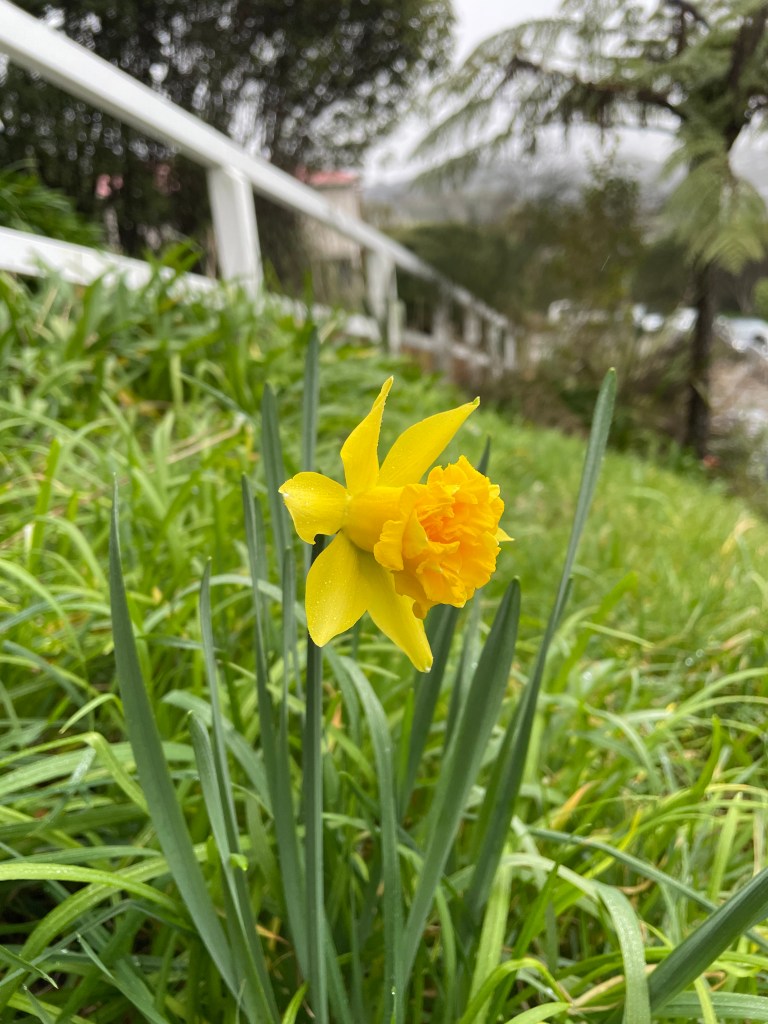
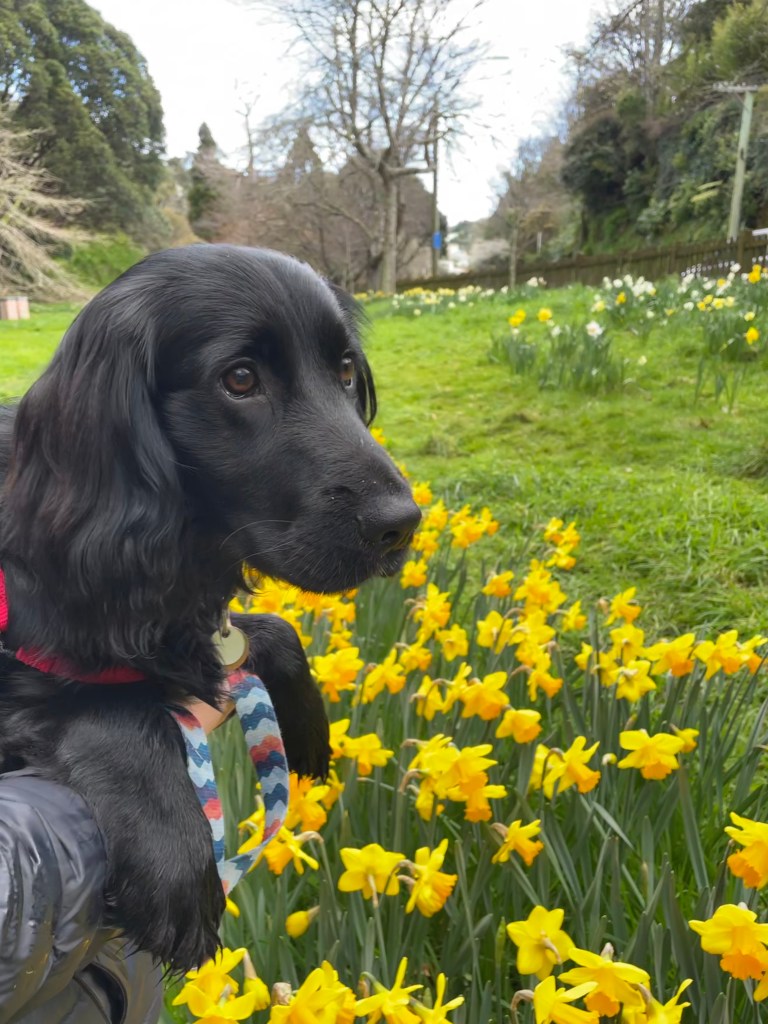
Daffodils bloom in Aotearoa at the opposite end of the year to St David’s Day, but they spark memories of Welsh spring. An unplanned pair popped up next to our path this week, and we showed Sprocket a meadow full at the Botanic Gardens.
Paper
There’s a small tree with big marbled leaves on our jungly bank, which I’ve learnt is the NZ native rangiora (Brachyglottis repanda).
The big papery leaves have a furry white underside, which is apparently pretty reasonable for writing a letter on, or a luxurious option for wiping your backside (they are nicknamed “bushman’s toilet paper”). They’re not so helpful at the start of the digestive journey, being fairly toxic if you happen to eat one. Honey made with rangiora nectar is also poisonous, so I’ll keep redirecting bees towards my pair of mānuka.
We have about half a dozen rangiora scattered on the bank, some up to 2m tall. The lower ones are now trimmed to keep them out of dog’s reach, so he can focus his efforts on digging up ferns and jumping on top of my new kōwhai.
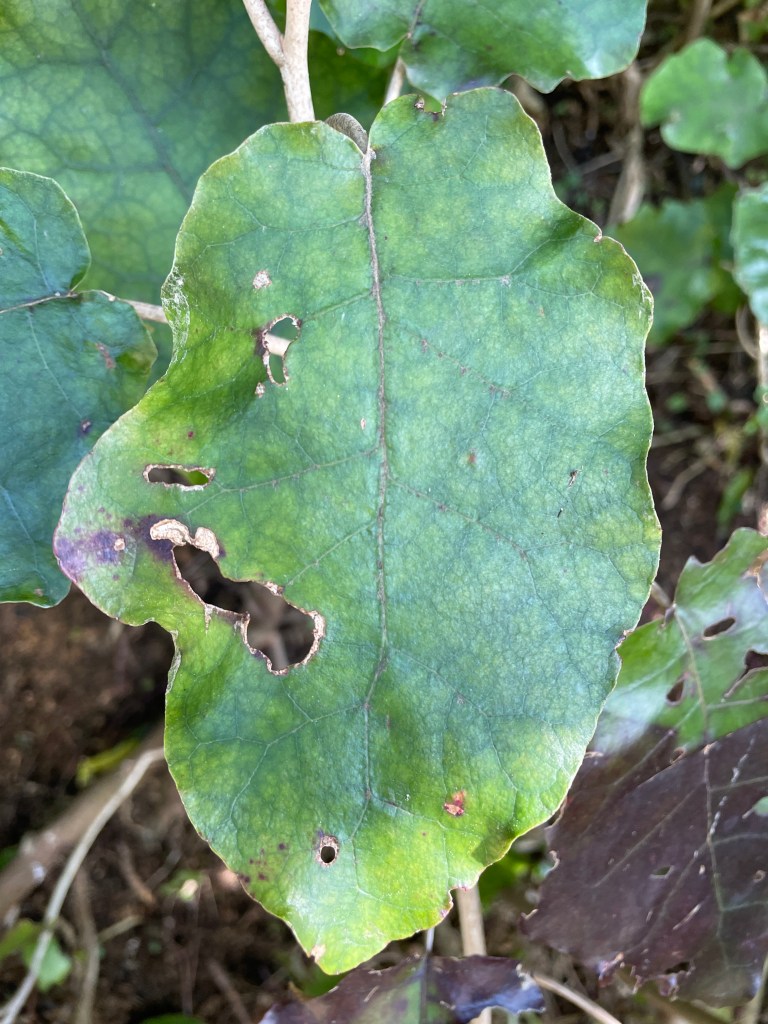
Rangiora leaf (munched) 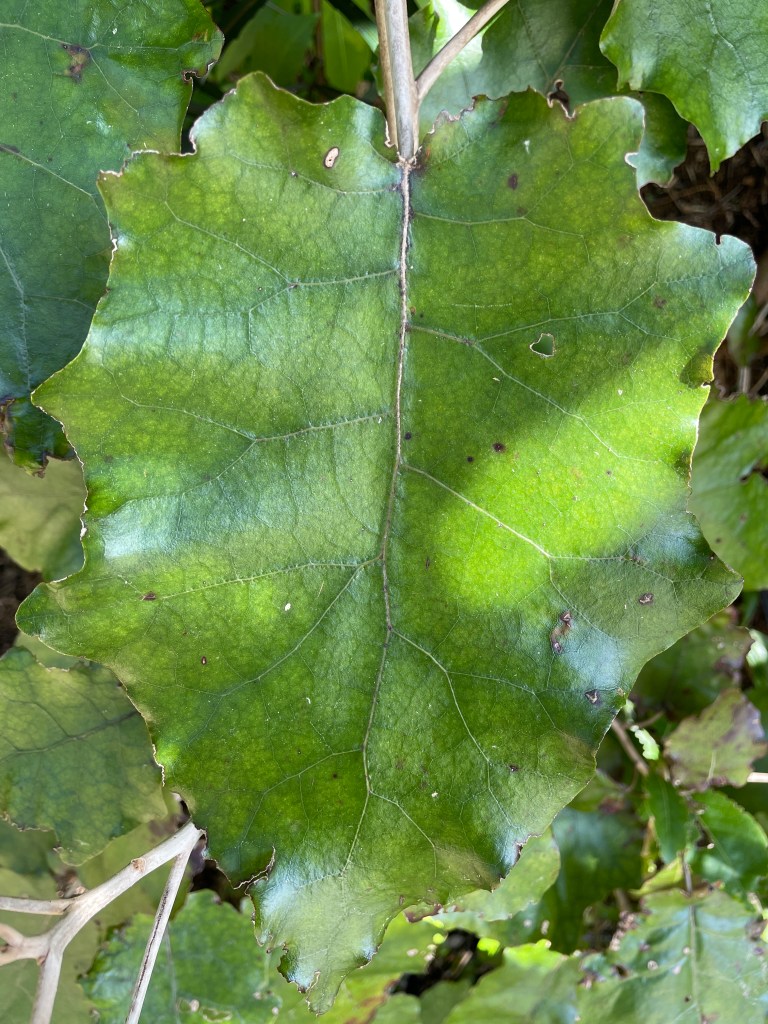
Rangiora leaf (non-munched)
Let it snow
The first weekend of NZ lockdown left plenty of time to annihilate the last of the path-lining agapanthus. I swapped tools from the spade to the grubber, swinging satisfyingly into the remaining clumps. The final set of roots was a the most tenacious—a multi-headed Hydra that needed dividing into two just to lift out of the ground.
After raking the root remnants, we planted two ‘Snow Flurry‘ mānuka/tea tree (leptospermum scoparium). They’re often chosen for making honey, but with a pair of trees sadly we may only sustain one bee. We chose it for its ability to thrive in dubious soil, and the clay here looked pretty intent on ruining anything I planted. Go, little mānuka, go.
We bark mulched, laid some rocks at the edge, and cleared the old drain alongside the path. It looks… good? I’m proud and a bit surprised at our efforts. Sprocket hasn’t even tried to excavate it all yet.
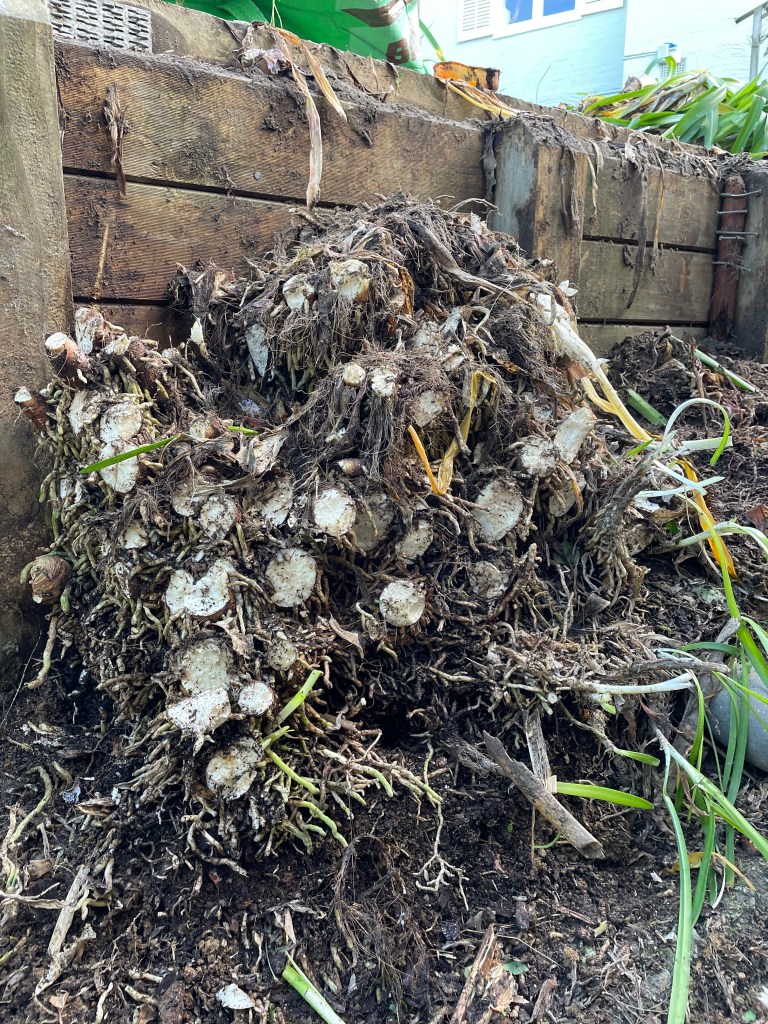
Agapanthus final boss 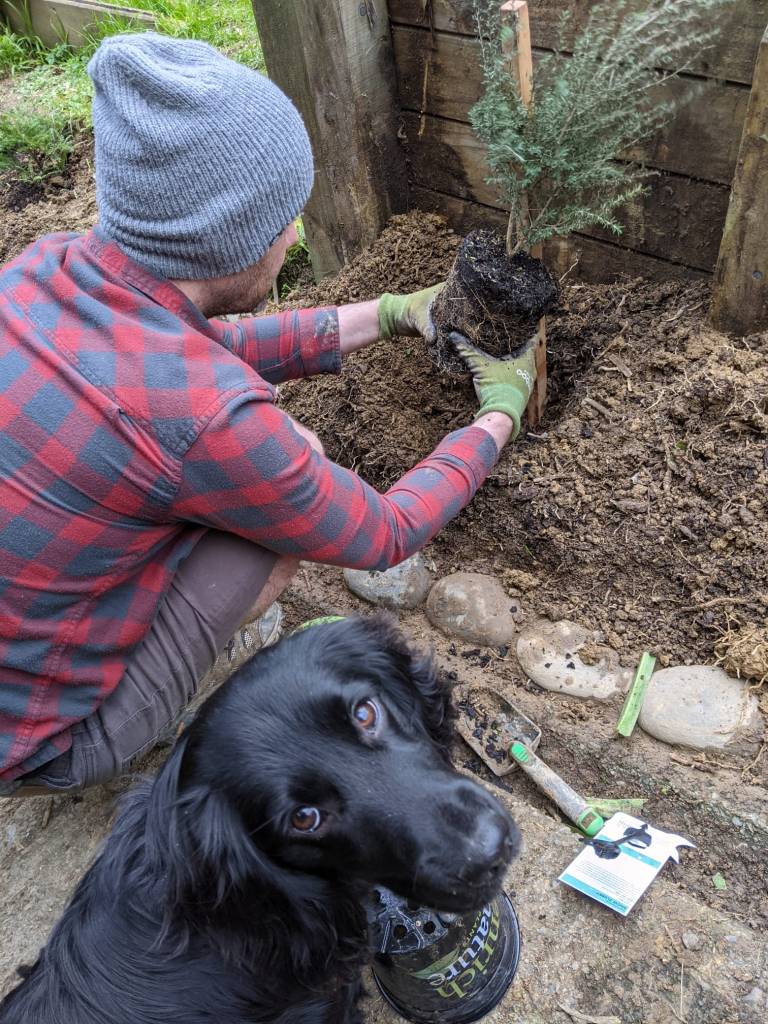
Planting the mānuka 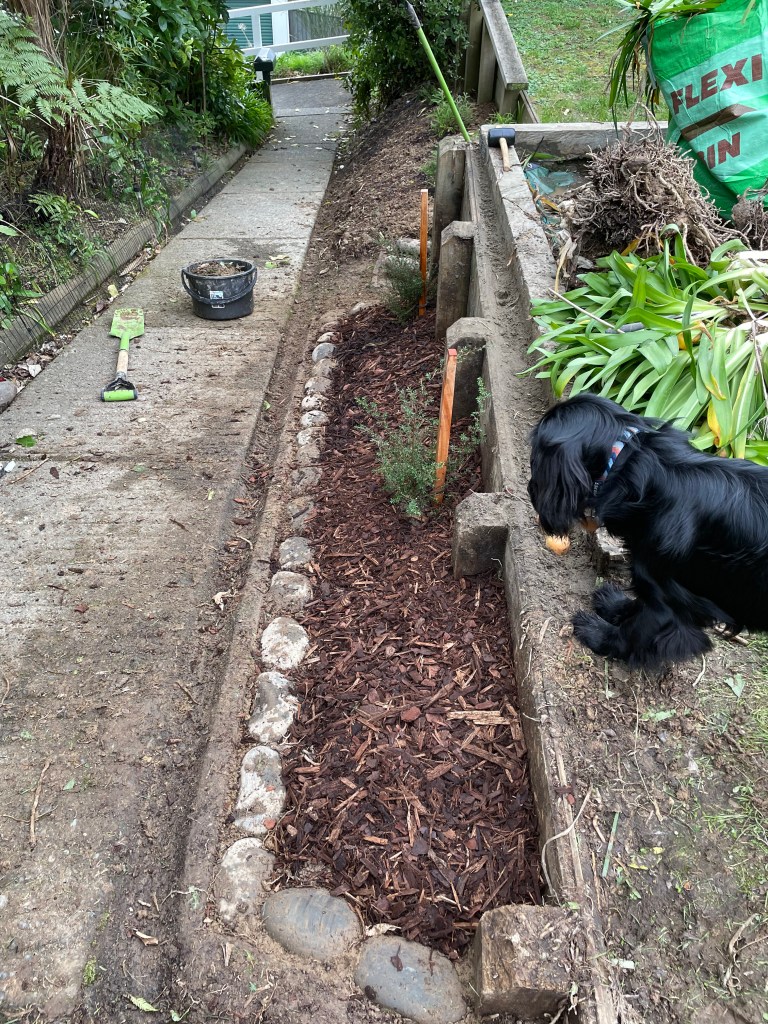
Inspection by branch manager 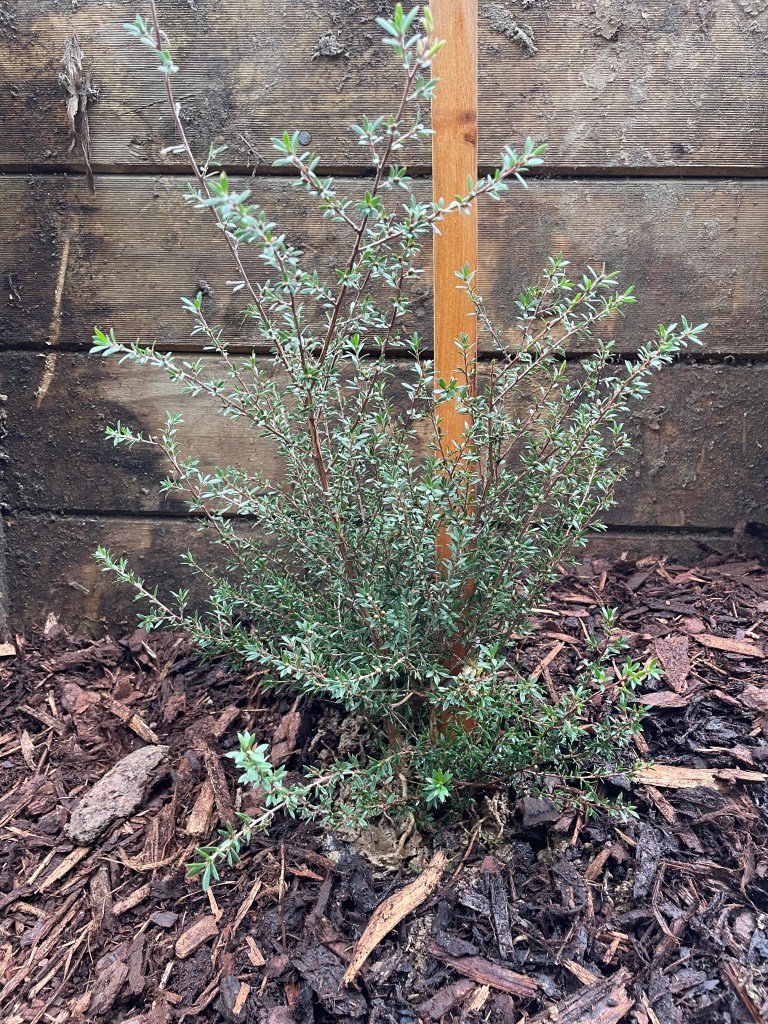
‘Snow flurry’ mānuka 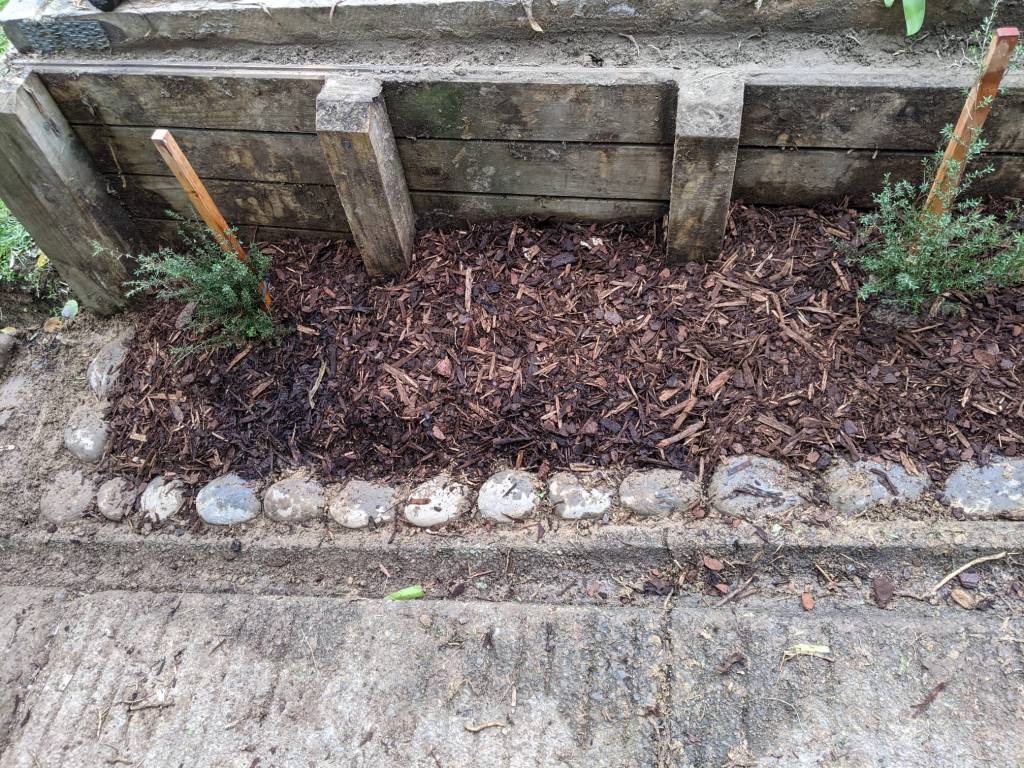
Rocks!
Sawtooth
I’m enjoying roaming around the garden and pointing the PlantNet app at things. One small shrub I liked had slim jagged leaves with a median stripe. I was also curious about the tall bushy-topped trees that tower over the left-hand side of the house. Today I found out that these two were actually the same species: lancewood/horoeka (pseudopanax crassifolius). They look so different! I learnt that having wild contrasts like this between juvenile and adult plants is called “heteroblasty“.
One theory goes that the long-extinct moa wasn’t fond of grazing on the spiky leaves, but once the tree was beyond moa height, it no longer had to defend itself. The mature trunk is branch-less and the leaves high up in the canopy are broad and without teeth.
We have a few similar but wider-leaved plants on our jungly bank that look like they could be a coastal five-finger/houpara (pseudopanax lessonii) instead, or a hybrid of the two. At least some of the lancewood seem to have self-seeded because they appear in a few peculiar spots: hiding under the big camellias, and lurking by the letterbox.
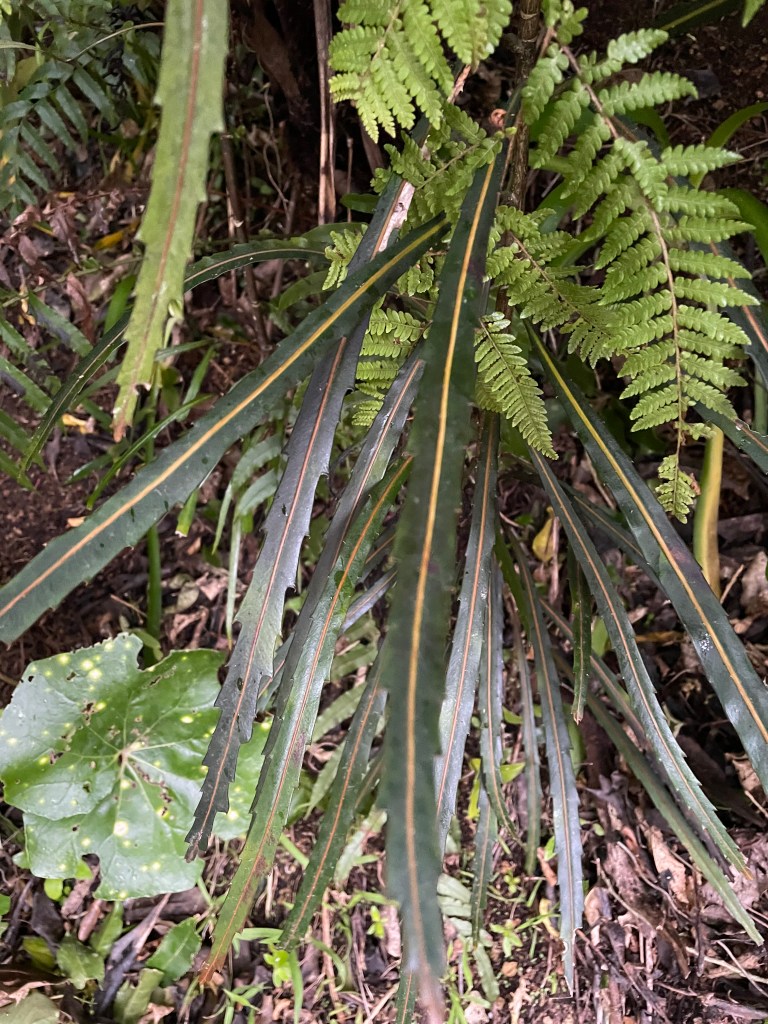
Pseudopanax crassifolius 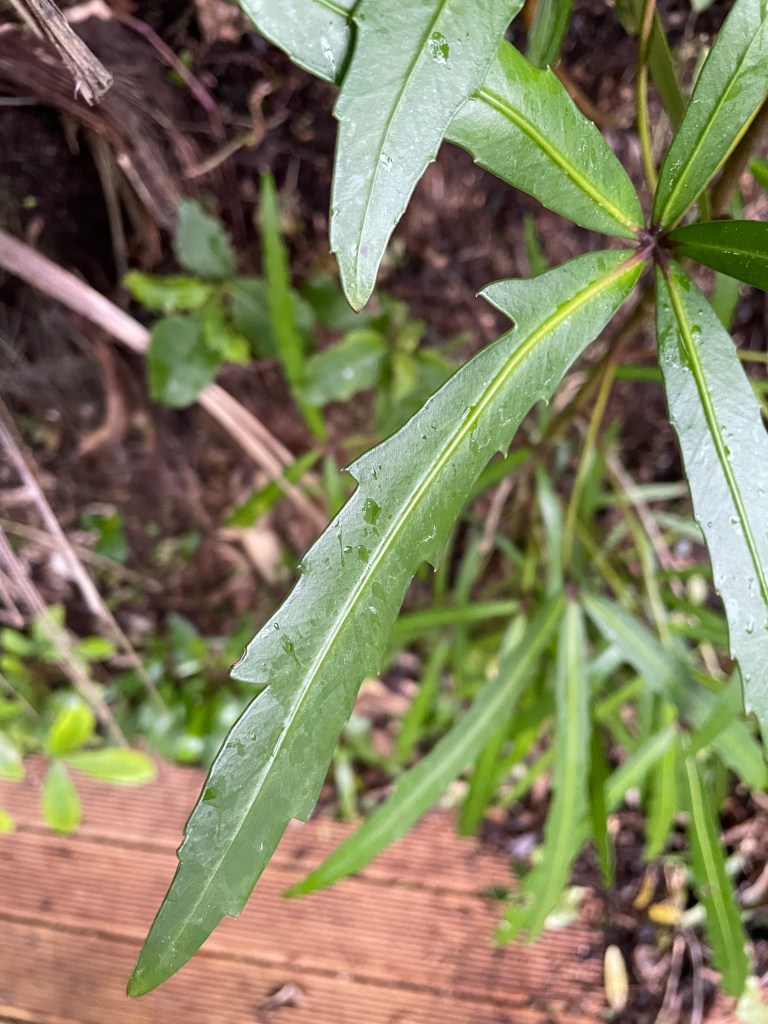
Pseudopanax crassifolius 
Pseudopanax lessonii or a hybrid? 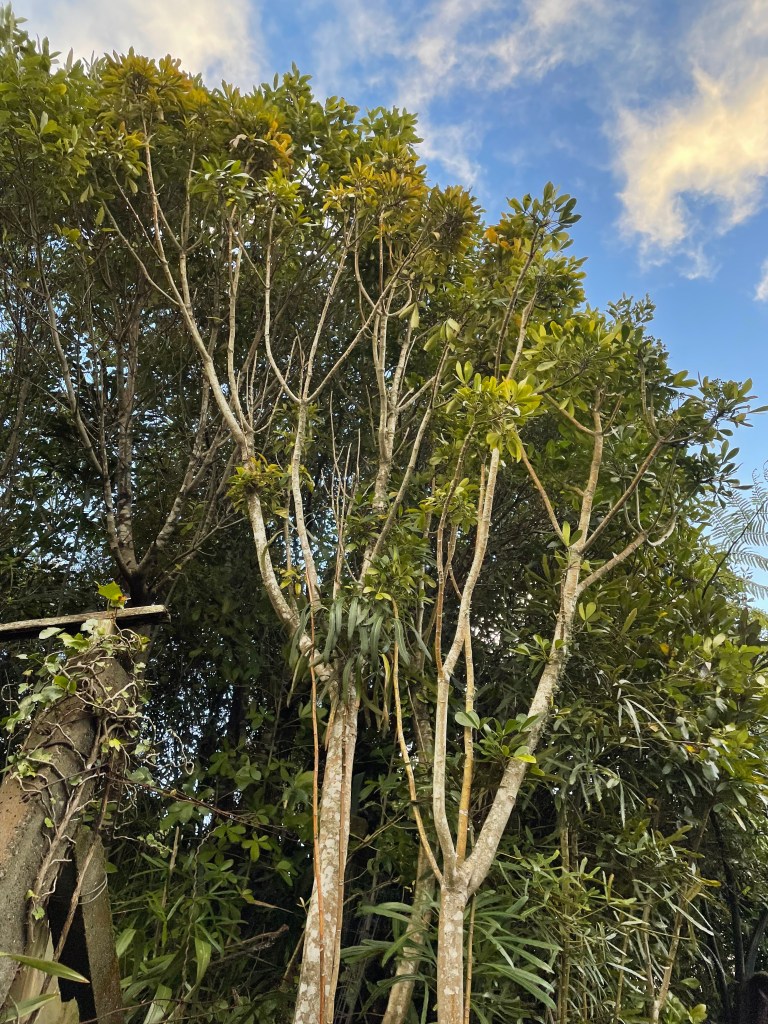
Grown-up lancewood. These are over 10m tall.
Frost
I’ve only ever seen a handful of Wellington mornings with frosted rooftops and icy fields. Inevitably, today was one of them, a few days after planting tiny new trees. Hopefully they’ll make it through.
With the first stretch of agapanthus defeated, the dog came for a trolley ride around the garden centre. To start off the bare bank, we selected a pair of “Dragon’s Gold” kōwhai, some pratia pedunculata “Alba” for ground cover, and a couple of blechnum fluviatile ferns. I dug some compost into the leaden clay soil. The bank didn’t collapse, but perhaps a half-arsed line of rocks isn’t a good way to retain it.
The next strip of path-side agapanthus is proving formidable. Their sliced roots look like halved coconuts. We have a couple of mānuka ready to go in when I’m finished, but to get to that point, the trench spade might need to be swapped for an axe or a flamethrower.

Two trees and a dog, please 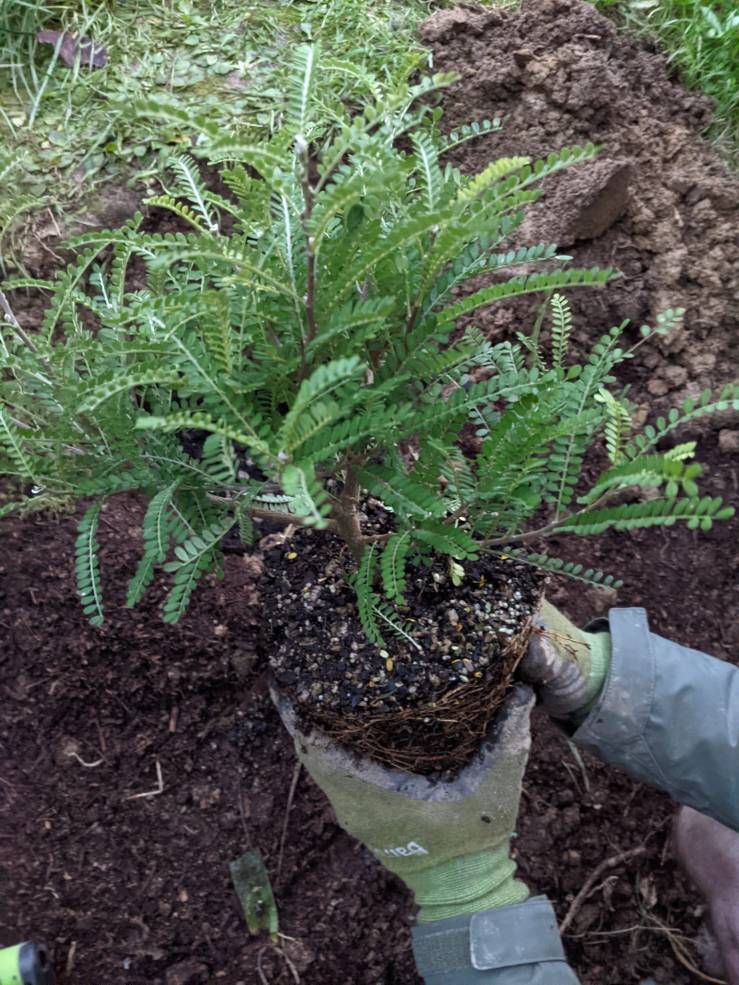
Sophora molloyi (kōwhai) ready to plant
The battle begins
Agapanthus are South African originally, also known as the Lily of the Nile, and were brought here quite deliberately. Another item, along with rabbits and gorse, on our long list of wrong-headed imports.
– The Agapanthus City, John Summers
Before I pulled on my first pair of gardening gloves, the giant purple flowers and glossy green clumps of agapanthus looked pretty exotic to me. When we moved in to the house, I was happy enough to leave the long line of them along our pathway.
When I learnt it was an invasive weed in NZ, I began to see it everywhere. I started digging out isolated plants, one smothering a small kōwhai on the bank. Progressing to the bigger ones, I had a begrudging respect for how tenaciously they held on even in clay banks with poor soil. The garden bin filled up with green leaves, giant roots and spongy rhizomes every week.
We’ve got about 10 metres of agapanthus alongside our path and a huge three-deep row of them at our front fence. Although they’ll be a feisty opponent I’ve decided they have to go, with native trees and ground covers planted in their place.
Me and Sprocket got through our first few metres of path-side ‘panthas this morning, learning to remove in reasonable slices so they can still be carried afterwards. A thin, sharp trench spade seems to do the trick. We’re due a big storm tomorrow and I’m hoping the remaining bank won’t vanish in the downpour.
The dog fared the best out of the morning’s back-breaking efforts, scoring five new balls to gallop around the garden with (one cricket, three tennis, one ping-pong). The long-undisturbed leaves were also hiding a cracked pāua shell, foam darts, hosepipe fittings and an extended family of snails.
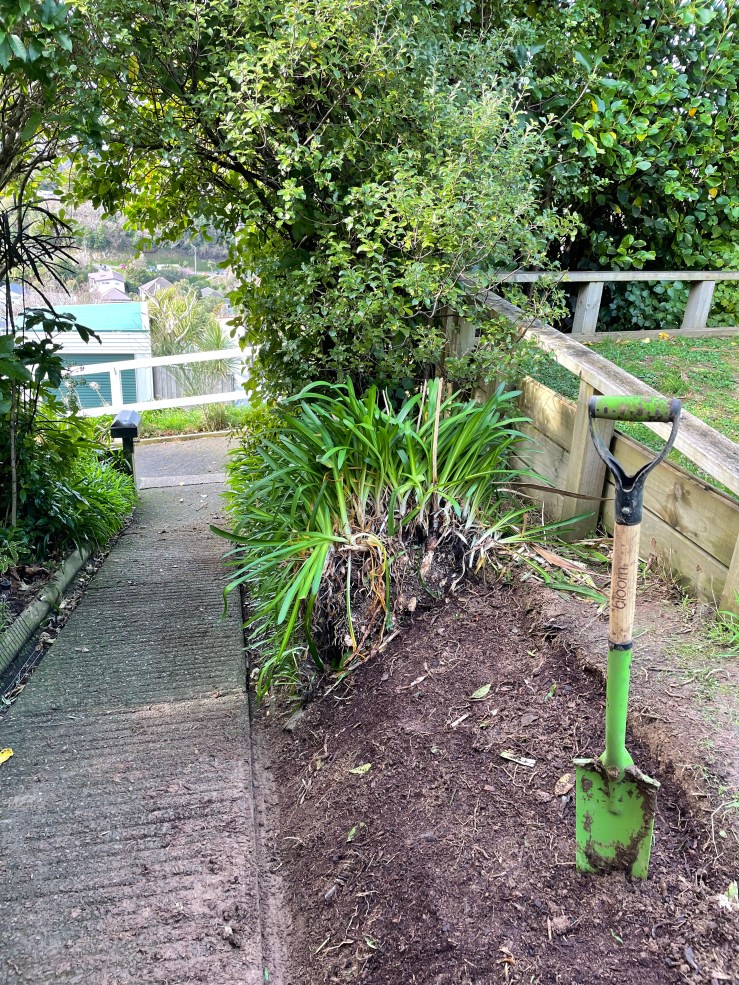
Bye bye agapanthus 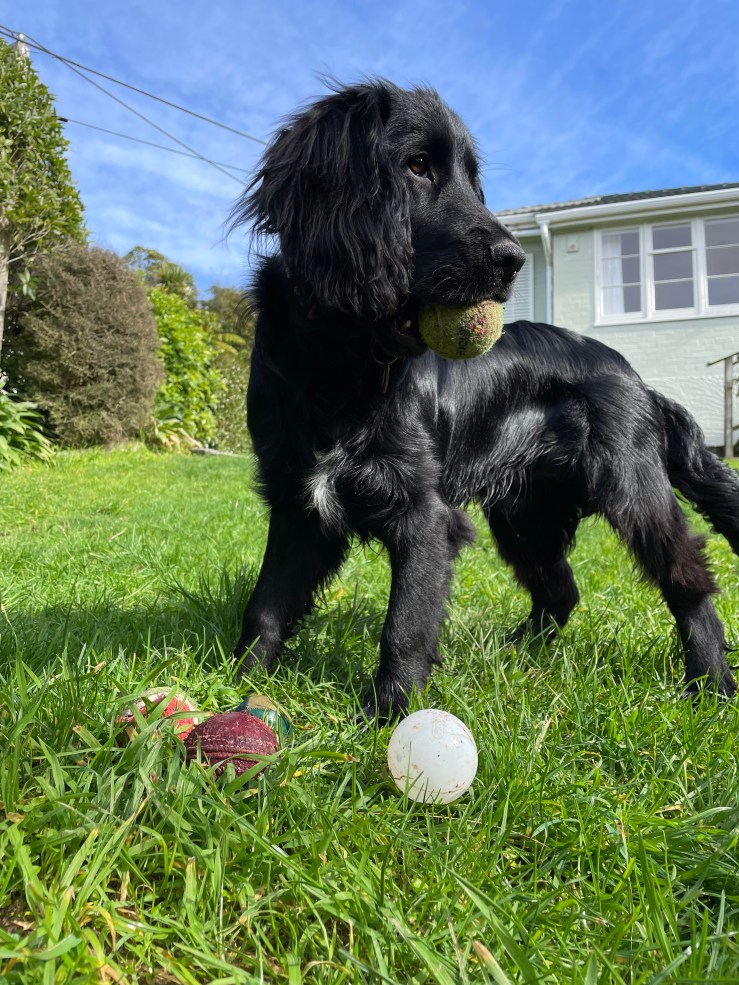
Sprock’s ball haul
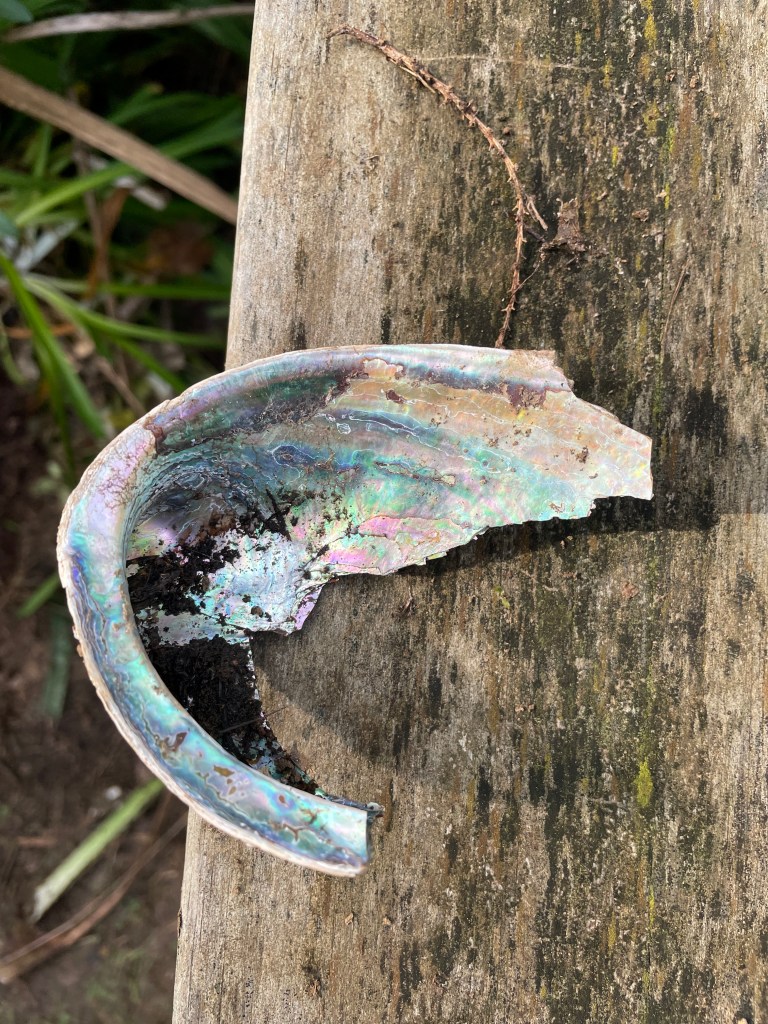
I’ve got the pāua 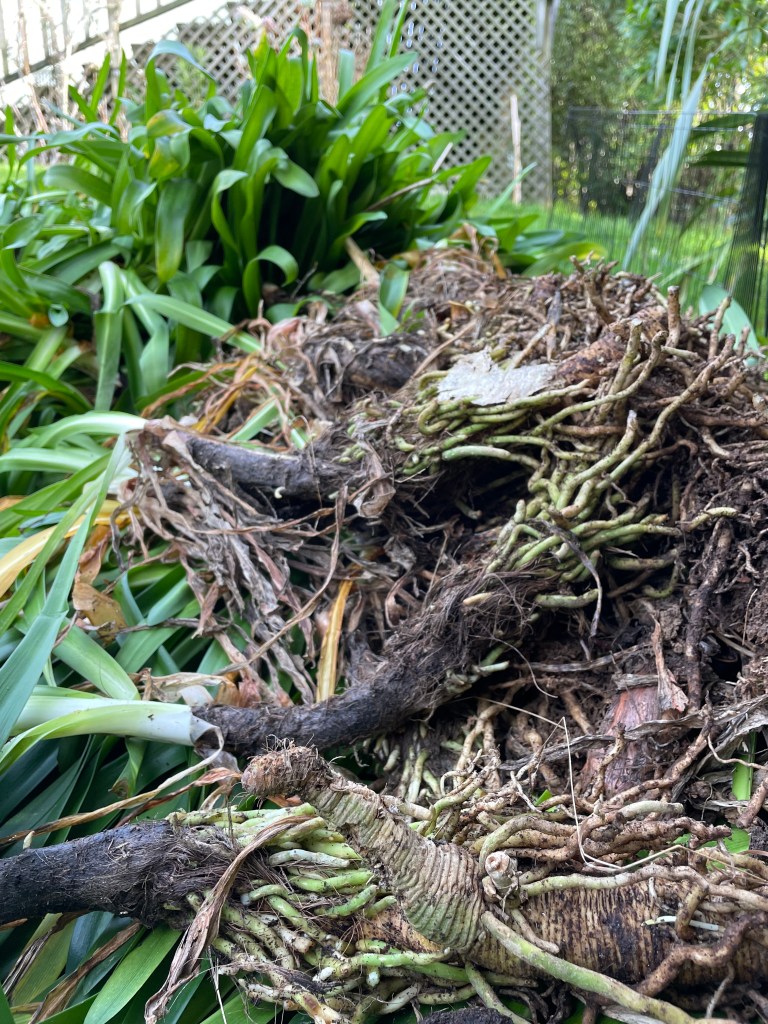
Rhizomes and roots
Narutomaki
Today is the end of solar winter in Aotearoa – the six weeks either side of the winter solstice. The mornings are still chilly but the days are lengthening slowly.
The first to flower ahead of spring are our camellia japonica. We have six trees in a row, which I think are the Margaret Davis variety. The flowers are white with dark pink edges. The colours remind me of the pink-swirled disc you’re served in a satisfying bowl of ramen (narutomaki).

Camellia japonica 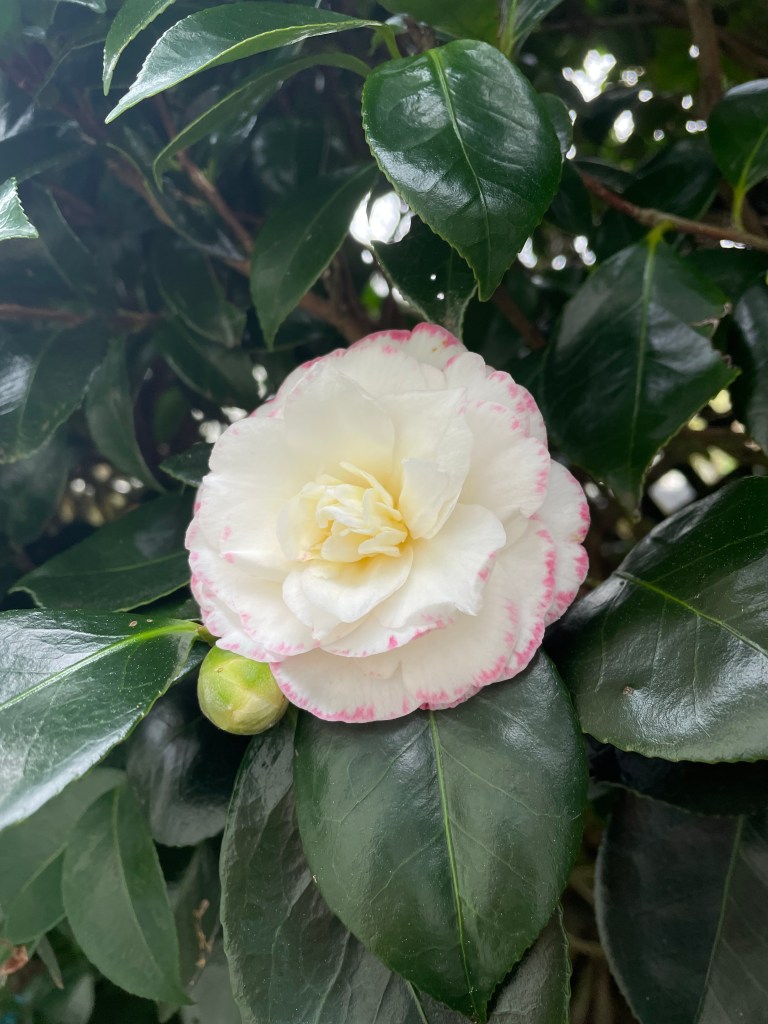
Camellia japonica
Putting down roots
I’ve been meaning to do a volunteering day on the Peak for years and finally made it out for some planting yesterday. It was a rare sunny and windless winter day, and we planted a few wheelbarrows-full of rimu, totara, tī kōuka and other natives along Leaping Lizard. It was my first time wielding a grubber and the first trees I’ve ever planted in the wild.
We spotted some of the NZ-native clematis paniculata (Puawhananga) flowering high up in a trail-side tree. It was inspiring to explore some of the early plantings from over twenty years ago and see how well-established they already are.
I asked lots of silly questions and got lots of useful answers. There was some chat about clubmoss being problematic, and coincidentally spotted some on a ride today and thought it looked interesting. The one I spotted seems to be Lycopodium volubile (waewaekoukou) which is native and maybe not the quite-similar-looking African club moss which definitely a weed. Lots to learn.
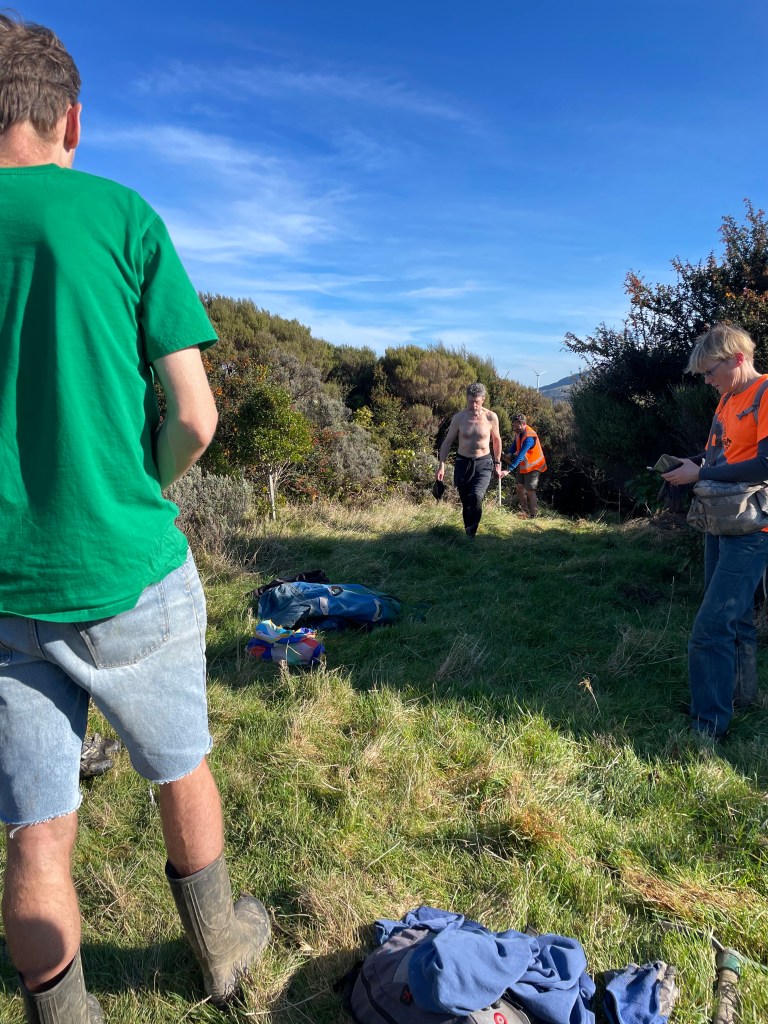
Gumboots and Tim Tams 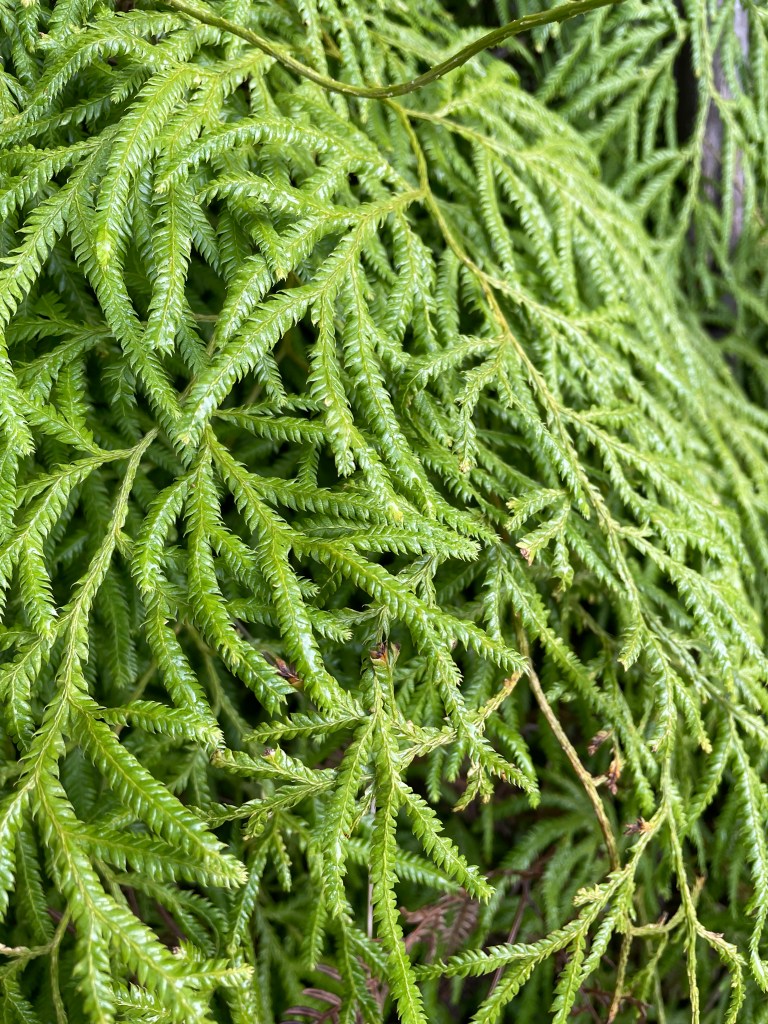
Mossy friend or foe
The beginning
We moved into Alba in January 2021, clueless but enthusiastic about the garden.
First plantings in May were a blechnum penna-marina by the little green shed, which Sprocket likes to try and dig up. We also planted two feijoa trees: an Apollo on the lowest level and a Pounamu near the deck. The Pounamu isn’t looking great but the Apollo is showing promising signs of being an actual fruit tree one day.
I’ve been pulling up tradescantia wherever I find it and also a fair bit of barberry, cotoneaster and agapanthus. I discovered a long-forgotten rugby ball concealed in the undergrowth. The right side of the bank is bit bare after weeding so I’ve tried to plant some groundcovers: a couple of pratia angulata (panakenake) and some leptinella ‘Platts Black’. One of the panakenake is looking good and started crawling a little. Tempted to try some climbers planted at the bottom of the bank like muehlenbeckia complexa. Clumsily I knocked out out a little mamaku fern when I was climbing up there. I’ve bought a rope ladder for better access to the upper bank, and also fun.
The mamaku grow and drop fronds at an amazing rate. We found a Wellington tree wēta in one of the fallen ones, and Sprocket has enjoyed munching the branches when given half a chance.
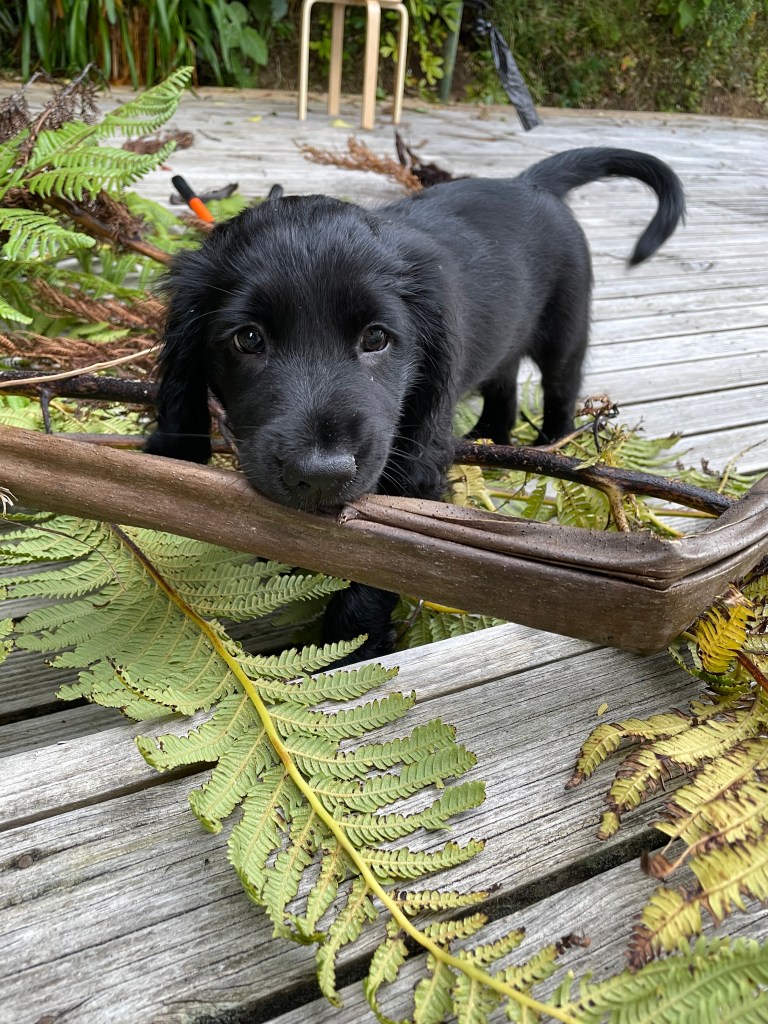
Pup munching on mamaku 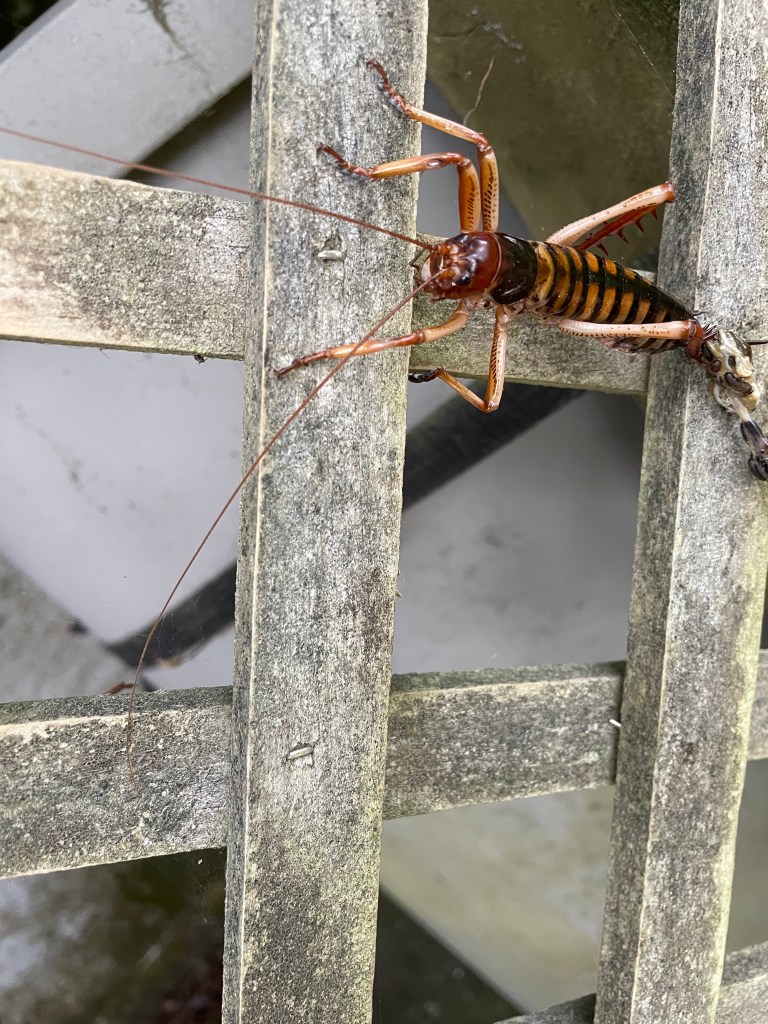
Wellington tree wēta
I’ve cleared the very weedy strip at the front by the road (full of nightshade, blackberry and friends) ready for a few trees, leaving only a nice-looking lily which I valiantly protected. I later discovered it was an arum lily (aka death lily ☠️) and promptly dug it out!
 kōwhai